
Table of Contents
Introduction – Aru Padai Veedu as a Complete Spiritual Life System
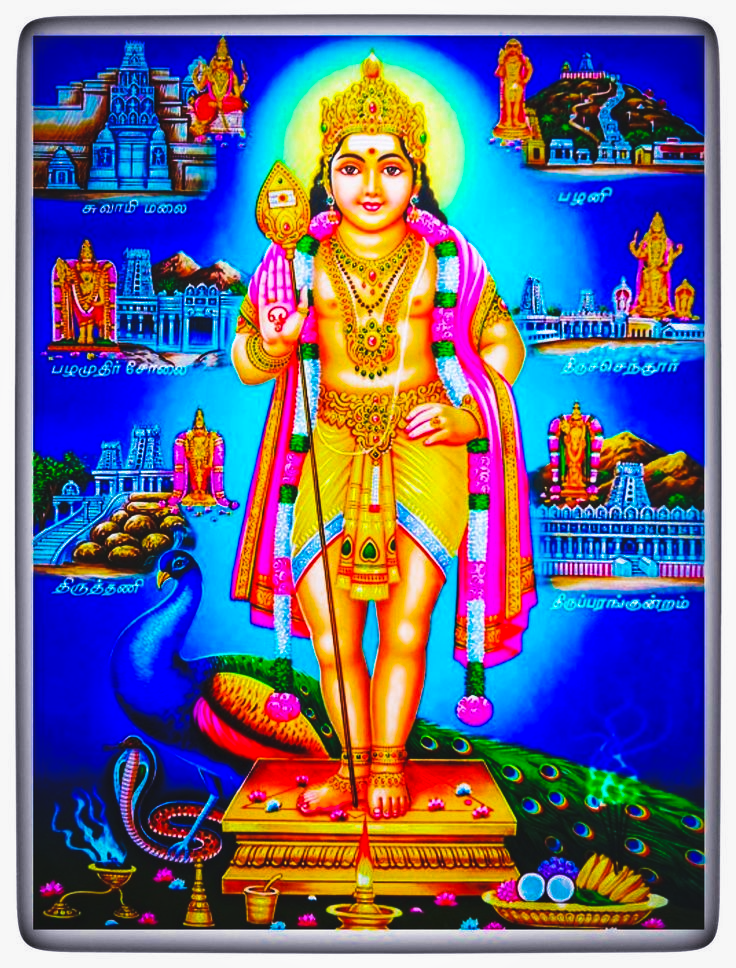
Lord Murugan, revered as Vel Murugan, Skanda, Subramanya, Kartikeya, and Senthil Andavar, occupies a unique and unparalleled position in Hindu spirituality. Unlike other deities whose legends are largely symbolic or localized, Murugan’s divine journey is mapped across real geography through the Aru Padai Veedu—the Six Sacred Abodes.
The Aru Padai Veedu is not just a pilgrimage circuit; it is a complete spiritual blueprint for human life. Each abode represents a distinct stage of evolution—victory, courage, renunciation, wisdom, peace, and divine grace. Together, they form a progressive path guiding devotees from worldly struggles to spiritual fulfillment.
What makes Lord Murugan’s Aru Padai Veedu extraordinary is its deep Tamil civilizational root. The six abodes are clearly documented in Tirumurugatrupadai, a Sangam-era masterpiece composed by Nakkirar, dating back over 2,000 years. This makes Murugan worship one of the oldest living religious traditions in the world.
Pilgrims believe that completing the Aru Padai Veedu journey removes karmic blocks, strengthens family and career life, sharpens wisdom, and ultimately leads to inner liberation. This hub article serves as the cornerstone guide, supported by six in-depth pillar articles—one for each sacred abode.
Thiruparankundram – The First Aru Padai Veedu of Lord Murugan (Victory & Divine Marriage)
Thiruparankundram holds an unparalleled position in Tamil spiritual history as the First Aru Padai Veedu of Lord Murugan. Located near Madurai in Tamil Nadu, this sacred hill temple marks the beginning of Murugan’s divine mission—his victory over the demon Surapadman and his marriage to Devasena, the daughter of Lord Indra. Unlike other Murugan temples, Thiruparankundram is not merely a place of worship; it is a symbol of triumph, responsibility, and righteous power.
Historical and Literary Significance
Thiruparankundram is glorified in Tirumurugatrupadai, a Sangam-era Tamil text composed by Nakkirar, dating back more than 2,000 years. This makes it one of the oldest continuously worshipped Murugan temples in India. The temple’s antiquity clearly establishes that Murugan worship is deeply indigenous to Tamil civilization, predating later Puranic expansions.
Sangam literature consistently refers to Thiruparankundram as the primary sacred abode where Murugan first established his divine presence after fulfilling his cosmic duty.
Unique Cave Temple Architecture
One of the most striking features of Thiruparankundram is that it is a rock-cut cave temple, carved directly into a massive granite hill. This architectural style symbolizes unshakeable divine will and stability. Unlike freestanding temples, the sanctum here feels inseparable from nature, reinforcing the idea that divinity is embedded in the land itself.
Inside the sanctum, Lord Murugan is seated majestically with Devasena, marking this as the only Aru Padai Veedu that emphasizes grahastha dharma (householder life). Murugan faces west, a rare orientation, believed to grant victory over enemies and negative forces.
Spiritual Importance and Deities
Thiruparankundram is unique in housing multiple deities within the same sacred hill:
- Lord Murugan with Devasena
- Lord Shiva as Parangirinathar
- Goddess Parvati
- Lord Vishnu
- Lord Ganesha
This represents Shaiva–Vaishnava harmony, a defining feature of ancient Tamil spirituality.
Spiritual Benefits of Worship
Devotees believe that worshipping at Thiruparankundram grants powerful blessings, especially related to victory and stability:
- Success in court cases, competitions, and conflicts
- Removal of career stagnation
- Harmony in marriage and family life
- Strength to overcome enemies and jealousy
Many devotees visit this temple before major life events such as marriage, new jobs, or legal matters.
Why Thiruparankundram Comes First
Thiruparankundram is considered the first Aru Padai Veedu because it represents the completion of duty before enjoyment. Murugan defeats evil first, restores dharma, and only then enters married life. This sequence teaches a profound life lesson: victory through discipline leads to rightful prosperity.
Key Takeaway
Thiruparankundram is far more than a historical temple—it is a spiritual foundation stone of Murugan worship. As the First Aru Padai Veedu, it sets the tone for the entire pilgrimage journey, reminding devotees that courage, responsibility, and righteous action are the true sources of lasting victory.
For anyone seeking success with dharma, Thiruparankundram remains an eternal beacon of divine power and balance
Internal Link Suggestion: /thiruparankundram-first-aru-padai-veedu
Thiruchendur – The Second Aru Padai Veedu of Lord Murugan (War, Justice & Courage)
Thiruchendur stands as the Second Aru Padai Veedu of Lord Murugan, uniquely located on the shores of the Bay of Bengal in Tamil Nadu. Among all Murugan temples, Thiruchendur is exceptional—not only because it is the only seaside abode, but also because it marks the climax of Murugan’s cosmic battle against the demon Surapadman. This sacred site symbolizes war, divine justice, courage, and the destruction of ego.
Mythological Background and Divine Battle
According to ancient tradition, Surapadman and his brothers had unleashed tyranny upon the Devas, disrupting cosmic order. Lord Murugan, armed with the Vel (divine spear) gifted by Goddess Parvati, chose Thiruchendur as his battlefield. After an intense and prolonged war, Murugan defeated Surapadman, who finally surrendered and was transformed into the peacock and rooster, becoming Murugan’s vahana and emblem.
This transformation conveys a powerful spiritual message: true victory lies not in destruction, but in the transformation of ego into devotion.
Unique Coastal Temple Architecture
Unlike most Hindu temples that are elevated or inland, Thiruchendur is built directly on the seashore. The endless ocean represents the restless human mind and boundless ego, while Murugan’s calm presence symbolizes mastery over chaos.
One of the most remarkable features of the temple is the Naazhi Kinaru, a freshwater well located just meters away from the salt sea. Despite being surrounded by seawater, the well provides sweet water, symbolizing purity amid worldly turbulence.
Spiritual Significance of Senthil Andavar
At Thiruchendur, Lord Murugan is worshipped as Senthil Andavar, the embodiment of justice, valor, and righteous anger. Devotees believe this is the most powerful temple for confronting fear, injustice, legal troubles, and negative energies.
The temple is especially revered by those undergoing difficult planetary periods such as Rahu–Ketu dosha or Saturn transits, as Murugan here is said to grant courage and protection.
Devotional Benefits of Thiruchendur
Worship at Thiruchendur is believed to bestow strong spiritual and material benefits:
- Victory over enemies and adversaries
- Relief from debts and prolonged financial stress
- Protection from black magic and negative influences
- Strength to overcome fear, depression, and indecision
The temple is also famous for its powerful abhishekam rituals and Skanda Sashti celebrations, which reenact Murugan’s victory over Surapadman.
Thiruchendur in Tamil Literature
Thiruchendur is praised in Tirumurugatrupadai, affirming its antiquity and importance in Sangam-era Murugan worship. Later saints like Arunagirinathar further glorified Thiruchendur through their soul-stirring Thiruppugazh hymns.
Key Takeaway
Thiruchendur is not merely a place of worship—it is a spiritual battlefield where inner demons are confronted and conquered. As the Second Aru Padai Veedu, it teaches devotees that courage, discipline, and surrender to divine justice are essential for overcoming life’s fiercest struggles.
Standing firm between land and sea, Thiruchendur continues to inspire millions to face their fears and emerge victorious through the grace of Lord Murugan
Internal Link Suggestion: /thiruchendur-second-aru-padai-veedu
Palani – The Third Aru Padai Veedu of Lord Murugan (Renunciation & Supreme Wisdom)
Palani occupies a profoundly unique place among the Aru Padai Veedu, standing as the Third Sacred Abode of Lord Murugan and the most philosophically deep of all six temples. Located in the Dindigul district of Tamil Nadu, Palani represents Murugan not as a warrior or king, but as a renunciate yogi—the embodiment of supreme wisdom, humility, and self-realization.
The Divine Story of Renunciation
According to sacred tradition, Lord Shiva once challenged his sons, Ganesha and Murugan, to circle the universe to win the Jnana Pazham (fruit of wisdom). While Murugan set out across the physical cosmos, Ganesha symbolically circled his parents, declaring them as his universe. When Murugan returned and found the fruit awarded to Ganesha, he realized a profound truth—that wisdom lies beyond physical effort.
Deeply contemplative, Murugan renounced everything and withdrew to Palani, taking the form of Dhandayuthapani—the ascetic holding only a staff (danda). This act teaches that true knowledge arises from detachment and humility, not conquest.
Unique Iconography of Dhandayuthapani
At Palani, Murugan is worshipped without ornaments or weapons, unlike his majestic warrior forms elsewhere. He stands as a bare, youthful yogi, representing the shedding of ego and material identity. The hill itself symbolizes the spiritual ascent of the soul, with devotees climbing steps as an act of penance and surrender.
This form of Murugan is deeply connected with yoga, tapas, and inner discipline, making Palani one of the most powerful spiritual centers in South India.
Panchamirtham and Healing Traditions
Palani is world-famous for its sacred Panchamirtham, a divine mixture of banana, jaggery, ghee, honey, and cardamom. Prepared according to ancient temple traditions, it is believed to possess healing and purifying properties.
Devotees from across the world visit Palani seeking relief from:
- Mental stress and confusion
- Addictions and compulsive behaviors
- Chronic health issues and emotional suffering
Many consider Palani a spiritual healing center, where inner wounds are addressed through devotion and discipline.
Palani in Tamil Literature and Bhakti Tradition
Palani is extensively praised in Tirumurugatrupadai, confirming its status as an ancient Murugan worship site during the Sangam period. Later, saint Arunagirinathar elevated Palani’s spiritual stature through his powerful Thiruppugazh hymns, composed during intense personal struggle and redemption.
These hymns transformed Palani into a center of bhakti blended with self-transformation.
Spiritual Benefits of Worship at Palani
Devotees believe worship at Palani grants:
- Clarity in life decisions
- Detachment from destructive desires
- Emotional and mental healing
- Progress in spiritual practices
Palani is especially revered by students, seekers, monks, and those facing inner conflict.
Key Takeaway
Palani, the Third Aru Padai Veedu, stands as a timeless reminder that renunciation is not rejection, but realization. Through Dhandayuthapani, Lord Murugan teaches that the highest victory is not over enemies, but over ego and ignorance.
In a world driven by ambition and noise, Palani remains a sacred sanctuary of silence, wisdom, and inner awakening—guiding souls toward lasting truth through humility and surrender
Internal Link Suggestion: /palani-third-aru-padai-veedu
Swamimalai – The Fourth Aru Padai Veedu of Lord Murugan (The Supreme Guru of Wisdom)
Swamimalai occupies a unique and exalted position among the Aru Padai Veedu as the Fourth Sacred Abode of Lord Murugan. Located near Kumbakonam in Tamil Nadu, this holy temple is revered as the place where Murugan attained the status of Guru, even teaching Lord Shiva himself the profound meaning of the sacred Pranava Mantra (Om). Because of this divine event, Murugan here is worshipped as Swaminatha Swami, the Teacher of the Teacher.
The Pranava Upadesam – Murugan as Guru
According to sacred legend, Lord Shiva once asked his son Murugan to explain the true meaning of Om, the primordial sound from which creation emerged. Murugan responded by insisting that Shiva listen humbly as a student. Sitting atop Swamimalai hill, Murugan revealed the inner essence of the Pranava Mantra, establishing himself as the embodiment of supreme wisdom.
This moment marks a revolutionary spiritual idea in Hindu philosophy—that wisdom is independent of age or authority, and true knowledge transcends hierarchy. Swamimalai thus stands as an eternal symbol of the Guru–Shishya tradition, which later became the foundation of Indian spiritual learning.
Architectural and Symbolic Significance
The Swamimalai temple is built on a small hillock, approached by sixty sacred steps, each representing one year of the Tamil calendar cycle. Ascending these steps symbolizes the gradual accumulation of wisdom through time, discipline, and experience.
Murugan’s posture in the sanctum is calm and composed, reflecting the serenity of a realized teacher rather than the aggression of a warrior. The temple complex beautifully integrates Shaiva philosophy with Tamil spiritual symbolism, reinforcing Murugan’s role as Gnana Skanda, the lord of wisdom.
Spiritual Importance for Knowledge Seekers
Swamimalai is especially revered by:
- Students and scholars
- Teachers, lecturers, and spiritual mentors
- Writers, orators, and artists
- Those seeking clarity in mantra sadhana and meditation
Devotees believe worshipping Swaminatha Swami enhances memory, articulation, learning ability, and spiritual insight. Many parents bring children here before beginning formal education, seeking Murugan’s blessings for intellectual growth.
Swamimalai in Tamil Literature and Bhakti Tradition
Swamimalai is praised in Tirumurugatrupadai, confirming its ancient status in Sangam-era devotion. Later, saint Arunagirinathar composed several Thiruppugazh hymns here, emphasizing Murugan’s role as the eternal teacher who removes ignorance.
Tamil bhakti literature consistently portrays Swamimalai as the center of divine instruction, where sound, silence, and meaning converge.
Spiritual Benefits of Worship at Swamimalai
Devotees believe worship at Swamimalai grants:
- Academic success and intellectual clarity
- Mastery over speech and communication
- Guidance in life decisions
- Progress in spiritual studies and meditation
The temple is also considered powerful for overcoming confusion, indecision, and ignorance.
Key Takeway
Swamimalai, the Fourth Aru Padai Veedu, reveals Lord Murugan not as a conqueror of worlds, but as a conqueror of ignorance. Here, Murugan stands as the eternal Guru, reminding humanity that true power lies in wisdom, humility, and inner realization.
In an age overwhelmed by information yet starved of understanding, Swamimalai continues to illuminate the timeless path of knowledge, discipline, and divine insight through the grace of Swaminatha Swami
Internal Link Suggestion: /swamimalai-fourth-aru-padai-veedu
Thiruthani – The Fifth Aru Padai Veedu of Lord Murugan (Peace & Emotional Healing)
Thiruthani holds a deeply soothing and compassionate place among the Aru Padai Veedu as the Fifth Sacred Abode of Lord Murugan. Situated in the Tiruvallur district of Tamil Nadu, near the Tamil Nadu–Andhra Pradesh border, Thiruthani represents Murugan’s transition from a fierce warrior to a serene, loving deity. This sacred hill temple symbolizes peace after conflict, emotional healing, and divine love.
From Battle to Calm – The Spiritual Transition
After the intense battles at Thiruchendur and the renunciation at Palani, Lord Murugan arrived at Thiruthani to cool his divine anger and restore inner balance. Here, Murugan entered a state of calmness and compassion, demonstrating that even the fiercest warrior must eventually embrace peace.
It is at Thiruthani that Murugan married Valli, a tribal princess, symbolizing pure love that transcends social divisions, ego, and pride. This divine union teaches that true love is rooted in humility and understanding, not status or power.
Serene Hill Temple and Natural Energy
Thiruthani is located on a tranquil hill, far removed from the noise of cities and the turbulence of the sea seen at Thiruchendur. The cool breeze, gentle slopes, and peaceful surroundings create an atmosphere of deep mental calm.
Unlike the dramatic landscapes of other Murugan abodes, Thiruthani’s simplicity reflects its spiritual purpose—to heal the heart and quiet the mind. Devotees often report feeling immediate emotional relief upon entering the temple premises.
Thiruthani in Tamil Bhakti Tradition
Thiruthani gained immense prominence through the devotional works of Saint Arunagirinathar, who composed many soul-stirring Thiruppugazh hymns here. His compositions highlight Murugan’s compassionate nature and his ability to uplift devotees suffering from emotional pain and moral struggles.
Through Arunagirinathar’s hymns, Thiruthani became widely recognized as a temple of inner healing and divine reassurance.
Spiritual Benefits of Worship at Thiruthani
Thiruthani is especially revered by devotees seeking emotional and relational harmony. Worship here is believed to grant:
- Mental peace and emotional stability
- Relief from anger, anxiety, and fear
- Harmony in marriage and family life
- Success in love and relationship matters
Many devotees pray at Thiruthani before marriage or during periods of marital conflict, trusting Murugan’s grace to restore balance and understanding.
Unique Spiritual Identity
Unlike other Aru Padai Veedu that emphasize war, wisdom, or renunciation, Thiruthani focuses on restoration and emotional renewal. Murugan here teaches that peace is not weakness, but the highest form of strength—achieved only after self-mastery.
Key Takeaway
Thiruthani, the Fifth Aru Padai Veedu, stands as a sacred reminder that inner peace is as essential as outer victory. Through his gentle presence and divine love, Lord Murugan shows devotees how to heal emotional wounds, control anger, and embrace compassion.
For those burdened by stress, relationship struggles, or emotional turmoil, Thiruthani remains a timeless sanctuary—where the warrior god becomes the healer, and divine grace flows quietly into the human heart
Internal Link Suggestion: /thiruthani-fifth-aru-padai-veedu
Pazhamudircholai – The Sixth Aru Padai Veedu of Lord Murugan (Grace & Fulfillment)
Pazhamudircholai holds a deeply mystical and compassionate place among the Aru Padai Veedu as the Sixth and final Sacred Abode of Lord Murugan. Nestled amidst the lush greenery of the Alagar Hills near Madurai, this holy shrine represents the culmination of Murugan’s divine journey—where wisdom matures into grace, effort dissolves into fulfillment, and devotion is rewarded without struggle.
Unlike the other five abodes that emphasize victory, war, renunciation, or discipline, Pazhamudircholai embodies effortless divine compassion, making it one of the most spiritually gentle yet powerful Murugan temples.
The Avvaiyar–Fruit Legend and Spiritual Message
Pazhamudircholai is inseparably linked with the legendary Tamil poet-saint Avvaiyar. According to tradition, Murugan tested her humility by appearing as a young boy guarding a fruit tree. When Avvaiyar asked for a fruit, Murugan questioned whether she wanted a hot fruit or a cold fruit. Confused, Avvaiyar replied “hot,” prompting Murugan to shake the tree so that a fruit fell.
When Avvaiyar blew on the fruit to cool it, Murugan laughed, revealing that even a realized soul must remain humble. Through this divine play, Murugan taught that true wisdom matures only through humility.
This episode elevates Pazhamudircholai as a temple of gentle correction, loving grace, and spiritual completeness.
Nature as the Sanctum
One of the most unique aspects of Pazhamudircholai is that Murugan is worshipped in harmony with nature. Unlike other temples with grand iconography, this shrine emphasizes the forest, streams, and hill energy as manifestations of the divine.
Murugan is traditionally worshipped here with:
- Valli and Devasena
- Natural elements such as fruits, flowers, and water
- Minimal ritual rigidity
This reflects the idea that divinity ultimately transcends form, and grace flows naturally when ego dissolves.
Spiritual Benefits of Pazhamudircholai
Devotees believe worship at Pazhamudircholai grants:
- Fulfillment of long-standing prayers
- Grace without intense penance
- Balance between material success and spiritual peace
- Protection and prosperity through divine compassion
This temple is especially sought by devotees who feel spiritually mature yet seek divine reassurance rather than instruction.
Pazhamudircholai in Tamil Literature
Pazhamudircholai is celebrated in Tirumurugatrupadai, affirming its ancient Sangam-era sanctity. The temple’s association with Avvaiyar further cements its role in Tamil literary and spiritual heritage, bridging poetry, devotion, and philosophy.
Why Pazhamudircholai Comes Last
As the Sixth Aru Padai Veedu, Pazhamudircholai represents the final stage of spiritual evolution—where effort gives way to grace. After victory (Thiruparankundram), justice (Thiruchendur), renunciation (Palani), wisdom (Swamimalai), and peace (Thiruthani), Murugan bestows unconditional compassion here.
Key Takeaway
Pazhamudircholai is not merely a temple—it is a spiritual embrace. Here, Lord Murugan does not test strength or knowledge; he simply grants grace. As the Sixth Aru Padai Veedu, it completes Murugan’s divine cycle and the devotee’s inner journey.
For those who have walked life’s long path of effort and devotion, Pazhamudircholai stands as a sacred assurance that divine fulfillment arrives gently, naturally, and lovingly through humility and faith
Internal Link Suggestion: /pazhamudircholai-sixth-aru-padai-veedu
Aru Padai Veedu Pilgrimage Order and Karmic Meaning
The traditional pilgrimage order follows Murugan’s life journey:
- Thiruparankundram – Victory
- Thiruchendur – Justice
- Palani – Renunciation
- Swamimalai – Wisdom
- Thiruthani – Peace
- Pazhamudircholai – Grace