
Introduction – The Divine Science of the Five Elements
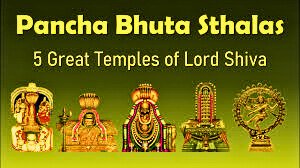
The Pancha Bhootha Sthalams form one of the most powerful and spiritually advanced systems of worship ever created in Indian civilization. These five sacred temples of Lord Shiva are not simply places of prayer—they are living manifestations of the five elemental forces that make up the universe itself: Earth (Prithvi), Water (Ap), Fire (Agni), Air (Vayu), and Space (Akasha).
In ancient Hindu philosophy, the universe is not divided into the spiritual and the material. Everything that exists—galaxies, planets, mountains, oceans, the human body, and even thoughts—is formed from these five elements. The sages of India realized that if the five elements within the human being are brought into balance, the soul naturally moves toward enlightenment. To guide humanity on this path, they consecrated Lord Shiva in these five elemental forms.
Lord Shiva’s Pancha Bhootha Sthalams represent one of the most profound spiritual concepts in Sanatana Dharma, where divinity is worshipped not merely as a form, but as the very building blocks of the universe. These five ancient temples, located in South India, symbolize the five fundamental elements—Earth (Prithvi), Water (Apas), Fire (Agni), Air (Vayu), and Ether (Akasha). Collectively, Lord Shiva’s Pancha Bhootha Sthalams teach that Shiva is not separate from creation; He is creation itself.
The philosophy behind Lord Shiva’s Pancha Bhootha Sthalams is rooted in both Vedic wisdom and Agamic temple science. According to Shaiva Siddhanta, the human body and the cosmos are composed of these five elements, and spiritual liberation is achieved by transcending them. Worshipping Lord Shiva’s Pancha Bhootha Sthalams is believed to help devotees purify these elements within their own body and mind.
The first among Lord Shiva’s Pancha Bhootha Sthalams is Ekambareswarar Temple, Kanchipuram, representing Earth (Prithvi). Here, Lord Shiva manifests as a naturally formed earthen Lingam. The temple emphasizes stability, patience, and grounding—qualities associated with the Earth element. This shrine stands as a powerful reminder in Lord Shiva’s Pancha Bhootha Sthalams that all life is rooted in the soil of existence.
The second of Lord Shiva’s Pancha Bhootha Sthalams is Jambukeswarar Temple, Thiruvanaikaval, symbolizing Water (Apas). The Lingam here is constantly bathed by underground springs, reflecting the life-giving and purifying nature of water. Among Lord Shiva’s Pancha Bhootha Sthalams, this temple uniquely demonstrates how divinity flows silently, nourishing everything without discrimination.
The third of Lord Shiva’s Pancha Bhootha Sthalams is Arunachaleswarar Temple, Thiruvannamalai, representing Fire (Agni). Unlike other temples, Shiva is worshipped here as a sacred hill of fire—Arunachala itself. The Karthigai Deepam festival, where a massive flame is lit atop the hill, powerfully illustrates the fiery aspect of consciousness highlighted in Lord Shiva’s Pancha Bhootha Sthalams.
The fourth of Lord Shiva’s Pancha Bhootha Sthalams is Sri Kalahasteeswara Temple, Srikalahasti, symbolizing Air (Vayu). This temple is famous for the mysteriously flickering lamp inside the sanctum, even without wind. It teaches that life breath (prana) is invisible yet essential. In Lord Shiva’s Pancha Bhootha Sthalams, this shrine connects spiritual awareness with the breath of existence itself.
The fifth and final among Lord Shiva’s Pancha Bhootha Sthalams is Chidambaram Nataraja Temple, representing Ether or Space (Akasha). Here, Shiva is worshipped as the Cosmic Dancer, performing the Ananda Tandava. The famed “Chidambara Rahasyam” (secret of space) reveals Shiva as formless consciousness. Lord Shiva’s Pancha Bhootha Sthalams reach their philosophical climax at Chidambaram, where emptiness itself becomes divine.
Together, Lord Shiva’s Pancha Bhootha Sthalams form a complete spiritual map—from solid matter to infinite space. They are not merely temples, but a living scientific-spiritual system created by ancient Tamil Shaivites. Pilgrimage to Lord Shiva’s Pancha Bhootha Sthalams is considered a journey through the universe and within oneself.
In essence, Lord Shiva’s Pancha Bhootha Sthalams remind humanity that divinity is present in every element we touch, breathe, see, feel, and transcend. Worshipping these sacred shrines is not just an act of devotion—it is an awakening to the cosmic truth that Shiva and the universe are one.
This is why the Pancha Bhootha Sthalams are considered not merely temples, but spiritual laboratories where the cosmic and the human meet.
Table of Contents
Why Lord Shiva Is Worshipped as the Five Elements
Lord Shiva is called Mahadeva, the supreme consciousness that exists beyond form and time. Yet, out of compassion for humanity, He manifests through the five elements so that devotees can experience Him in tangible form. Earth gives stability, water gives life, fire gives energy, air gives breath, and space gives existence itself.
The Pancha Bhootha Sthalams show that Shiva is not confined to the Lingam or idol — He is present in every atom of creation. This makes Shiva worship one of the most scientific and cosmic forms of spirituality.
Earth gives us stability and endurance.
Water gives us life and emotion.
Fire gives us energy and transformation.
Air gives us breath and movement.
Space gives us existence and awareness.
Together, these five elements form the foundation of creation. By worshipping Shiva in the Pancha Bhootha Sthalams, devotees do not merely pray—they align themselves with the very structure of the universe.
Earth Element – Ekambareswarar Temple, Kanchipuram
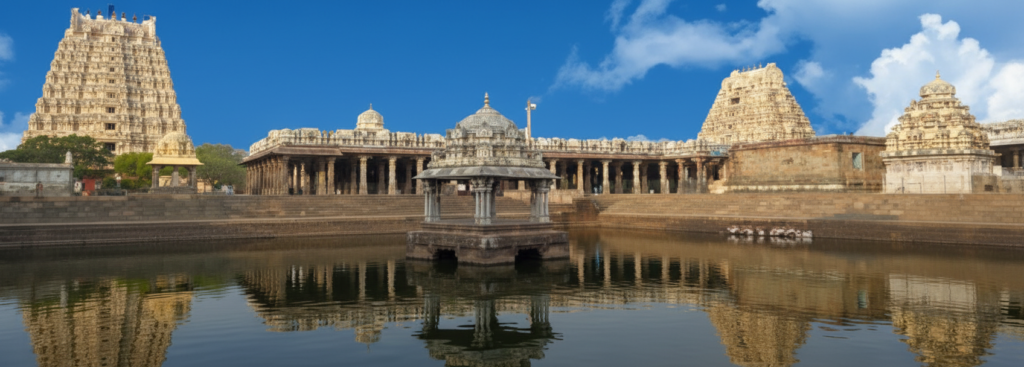
The Ekambareswarar Temple in Kanchipuram represents Prithvi (Earth), the most solid and stable of the five elements. Here Lord Shiva is worshipped as the Prithvi Lingam, a Lingam formed from sacred sand.
According to legend, Goddess Parvati once performed penance beneath a mango tree at this site. To test her devotion, Lord Shiva sent the River Ganga to flood her. Parvati prayed to Ganga as her sister, and the waters receded. She then shaped a Lingam from the wet earth and worshipped Shiva with unwavering devotion.
Moved by her love, Shiva appeared and accepted the Lingam. Even today, abhishekam is done with jasmine oil instead of water, because the Lingam is made of sand.
Earth symbolizes patience, grounding, and endurance. This temple teaches that spiritual growth requires steadiness—just as the Earth silently supports all life.
5 Facts about the Ekambareshwarar Temple
- The temple is the tenth largest temple in India, spread over 23 acres.
- It has one of the tallest Gopurams (monumental ornate gateway tower) in South India, at 190 feet.
- Having been in existence since at least 600 AD, the Ekambareshwarar temple is one of the most ancient temples in India.
- There is a mango tree inside the temple that is said to be more than 3000 years old.
- Many kings have contributed to the architecture of the temple.
Water Element – Jambukeswarar Temple, Thiruvanaikaval
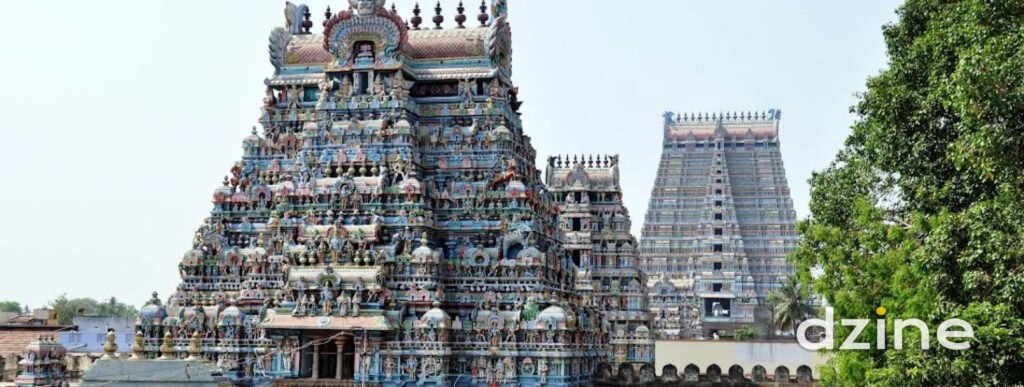
The Jambukeswarar Temple in Trichy represents the Water element (Ap). Here Shiva is worshipped as the Appu Lingam, surrounded by a natural underground water stream that flows continuously.
Goddess Parvati worshipped Shiva here as Akhilandeshwari and received Shiva Gnana, the ultimate wisdom. Because of this Guru–disciple relationship, the Shiva–Parvati wedding ritual is not performed here.
Water symbolizes wisdom, purification, emotional healing, and adaptability. Devotees believe that worshipping here removes mental blocks and grants spiritual clarity.
5 Facts about the Jambukeshwarar Temple
- The temple is around 1800 years old and was built by Kocenganna Chola.
- It is the thirteenth largest temple in India, spread over 18 acres.
- There are inscriptions on the walls of the temple from the Chola period.
- The Uchi Kala Pooja, which is conducted every afternoon, is very famous; in this pooja, the priests dress up in a saree, representing Goddess Parvathi, and perform Abhishekam on the Appu Lingam.
- It is said that the stream of water below the Appu Lingam never dries up.
Fire Element – Arunachaleswarar Temple, Thiruvannamalai
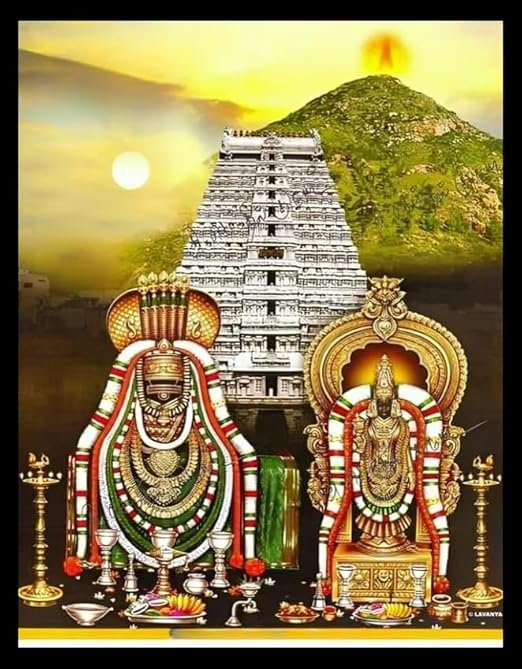
The Arunachaleswarar Temple represents the Fire element (Agni). Shiva manifested here as a pillar of infinite fire, proving His supreme nature.
The famous Lingothbhava story occurred here, where Shiva humbled Vishnu and Brahma. Arunachala Hill itself is considered Shiva in physical form.
Fire symbolizes transformation, spiritual awakening, and destruction of karma. Walking around the hill in Girivalam is believed to burn lifetimes of negative karma and grant liberation.
5 Facts about the Arunachaleshwarar Temple
- The largest temple in the world dedicated to the worship of Lord Shiva.
- The temple is said to be the eighth largest temple in India; it uses all its 24 acres area completely for religious purposes.
- The history of this temple dates back thousands of years and it has even been mentioned in sacred Tamil scriptures.
- Every full moon, thousands of pilgrims perform the Girivalam, which is a form of worship done by the circumambulation of the Arunachala hill. This is a 14-km long walk. The legend is that this walk washes away sins, fulfils desires, and gives one freedom from the cycle of birth and death.
- The temple has four Gopurams, one on each side. The highest of these is called Rajagopuram, which is 217 feet in height and is the third largest in India.
Air Element – Srikalahasti Temple
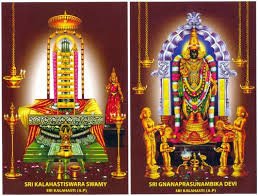
The Srikalahasti Temple is the Vayu Sthalam, representing the Air element. The Shiva Lingam here is called the Vayu Lingam, which moves mysteriously even when the sanctum is closed.
Shiva appeared here for Vayu Deva, blessing him to be present in all living beings. Air symbolizes life-force (Prana), breath, and vitality.
The Srikalahasti Temple in Andhra Pradesh represents the Air element (Vayu). The Shiva Lingam here moves mysteriously even when the sanctum is sealed, proving the presence of air energy.
This temple is famous for Rahu–Ketu dosha nivarana rituals. Air represents prana, breath, and life force. Without air, life ceases, just as without Shiva consciousness, existence is empty.
5 Facts about the Kalahastheeshwara Temple
- The initial structure of the temple was constructed in the 5th century. The active construction of the Srikalahasti continued for centuries after that.
- The main Gopuram is 120 feet high and was built in 1516 AD by the Vijaynagar King Krishnadevaraya. It is considered to be an architectural marvel.
- The Gopuram collapsed in May 2010 and is currently under renovation.
- The temple is famous for their Rahu-Kethu poojas. It is believed that the ill-effects manifesting due to the positioning and movements of the planets Rahu and Kethu can be warded off when this particular Pooja is performed with utmost devotion.
- It is said that the priests never touch the Vayu Lingam of the Kalahastheeshwara temple with their hands.
Ether Element – Chidambaram Nataraja Temple
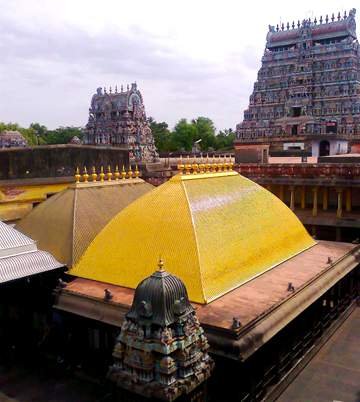
The Chidambaram Temple represents Ether (Akasha). Here Shiva is worshipped as Nataraja, the cosmic dancer, and also as formless space through the Chidambara Rahasya.
Behind a curtain lies empty space, symbolizing that the ultimate reality is invisible, limitless, and pure consciousness. Ether represents infinite awareness and divine presence.
Among the Pancha Bhootha Sthalams, Chidambaram holds the highest spiritual position because it represents Ākāśa (Ether or Space) — the subtlest, most powerful of the five elements. While Earth, Water, Fire, and Air are visible or felt, Ether is invisible, yet it contains and supports everything. In the same way, Chidambaram teaches that Shiva is formless consciousness that holds the universe itself.
5 Facts about the Thillai Nataraja Temple
- The temple is the fifth largest temple in India, expanding over a space of 40 acres, located in the heart of the town of Chidambaram.
- The word “Chidambaram” is derived from the word “Chit”, which means consciousness, and “Ambaram”, which means the sky. It refers to the “Sky of Consciousness”, which is the ultimate aim of human life.
- It is the only temple out of the Panch Bhoota Sthalam where Lord Shiva is represented by an anthropomorphic idol rather than the Lingam. The temple also worships Lord Shiva in the form of a Lingam made out of crystal and in his formless form (represented by an empty room).
- The Gopuram of the temple carries a gold-plated roof by the Chola King Parantaka.
- Legend has it that the temple is located at the lotus heart of the universe – Virat hridaya padma sthalam.
The Spiritual Science Behind Pancha Bhootha Sthalams
These temples correspond to the five chakras in the human body and form a complete yogic system. When the five elements within us are purified, the soul becomes free from suffering.
Conclusion
The Pancha Bhootha Sthalams represent one of the most powerful spiritual systems ever created. Through Earth, Water, Fire, Air, and Space, Lord Shiva reveals that divinity exists in every particle of creation.
These temples teach that true devotion is not escaping the world — but living in harmony with it. When we honor the five elements, we align with the cosmic rhythm and move closer to moksha, peace, and eternal bliss.
Shiva is not in the temple alone — He is in the air you breathe, the fire within, the water you drink, the earth you walk on, and the space you exist in.